
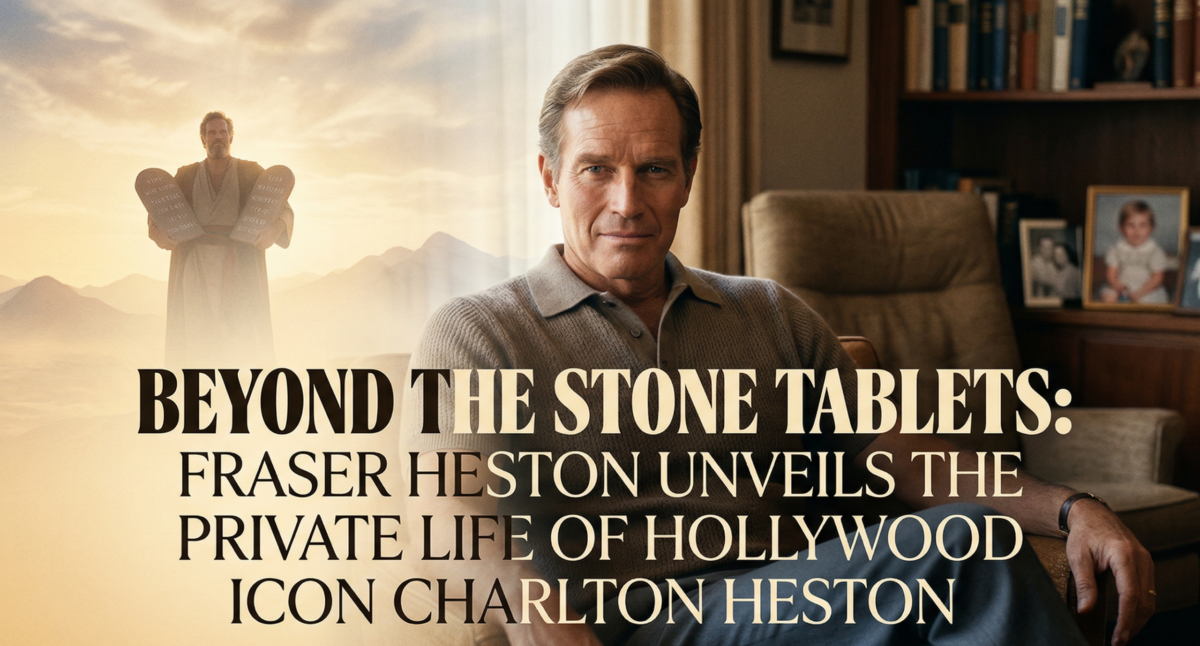
The thunderous voice of Charlton Heston remains one of the most recognizable sounds in the history of global cinema.
To millions of fans, he was the living embodiment of Moses, a man who could command the Red Sea to part with a single gesture.
Yet, the towering figures he portrayed on the silver screen often obscured the sensitive and disciplined man who lived behind the makeup.
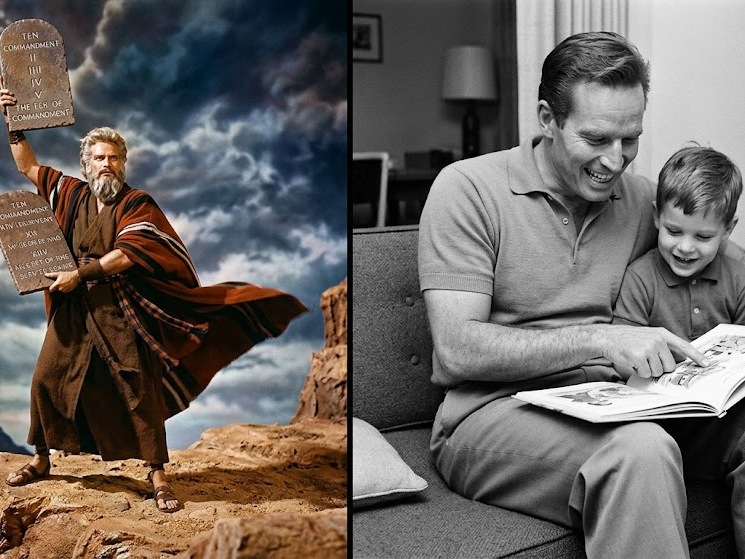
Recently, Fraser Clarke Heston, the son of this legendary performer, has begun sharing intimate stories that paint a much more human portrait of his father.
These revelations pull back the heavy velvet curtains of Hollywood’s Golden Age to show us the “truth” behind the myth.
It is a story that begins in the rugged woods of Michigan and ends in the quiet halls of a home filled with Shakespearean echoes.
By examining these new insights, we can finally understand how a humble Midwestern boy transformed into the ultimate cinematic titan.
This journey through the life of Charlton Heston is more than just a trip down memory lane; it is an exploration of character, family, and unyielding conviction.
From Michigan Wilderness to the Bright Lights of Broadway
Charlton Heston’s story does not begin in a glamorous Beverly Hills mansion or a high-society social club.
He was born into the modest heart of the American Midwest, where he spent his formative years exploring the dense forests of Michigan.
Fraser Heston often recalls how his father credited those early years of isolation and nature for his profound sense of self-reliance.
Young Charlton wasn’t chasing fame; he was chasing a craft, eventually finding his way to the prestigious theater programs of the era.
He brought a rare, theater-trained discipline to Hollywood, a place that was often more interested in looks than in literary depth.
His Midwestern upbringing provided him with a grounded perspective that never truly left him, even at the height of his international fame.
He viewed acting as a job that required the same physical and mental effort as any other trade.
This blue-collar work ethic would eventually become his trademark, allowing him to survive the most grueling film productions in history.
The Genesis of an Epic: The Real Story of ‘The Ten Commandments’
When we think of Charlton Heston, our minds immediately go to the 1956 masterpiece, The Ten Commandments.
However, for the Heston family, this film was far more than a blockbuster movie; it was a deeply personal family milestone.
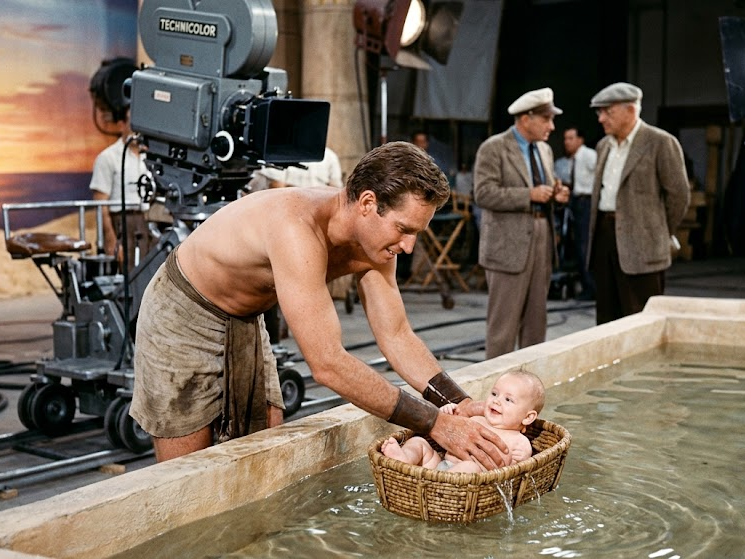
Fraser Clarke Heston famously made his cinematic debut in this very film as the infant Moses hidden in the river reeds.
“I am likely the only actor in history who managed to get a role from Cecil B. DeMille without even being able to walk,” Fraser recently joked.
The production was an absolute titan of effort, requiring Heston to endure the blistering heat of the Egyptian desert for months.
Fraser reveals that his father’s preparation for the role of Moses was incredibly intense and bordered on the scholarly.
Heston didn’t just read the script; he studied the Bible, ancient historical texts, and the weight of the prophetic tradition.
He felt a massive responsibility to the billions of people who held the story of Moses as a sacred part of their faith.
The “truth” of the set was one of dust, thousands of live animals, and a director who expected his lead actor to be as iron-willed as the character he played.
Charlton Heston rose to the challenge, solidifying his place as the go-to actor for the “Man of God” archetype.
The Chariot Race and the Physicality of ‘Ben-Hur’
If Moses gave him a voice, Judah Ben-Hur gave Charlton Heston his cinematic immortality and an Academy Award for Best Actor.
The 1959 epic Ben-Hur remains a high-water mark for practical filmmaking, specifically regarding the legendary chariot race sequence.
Fraser Heston has recently clarified many of the myths surrounding this dangerous and high-stakes production.
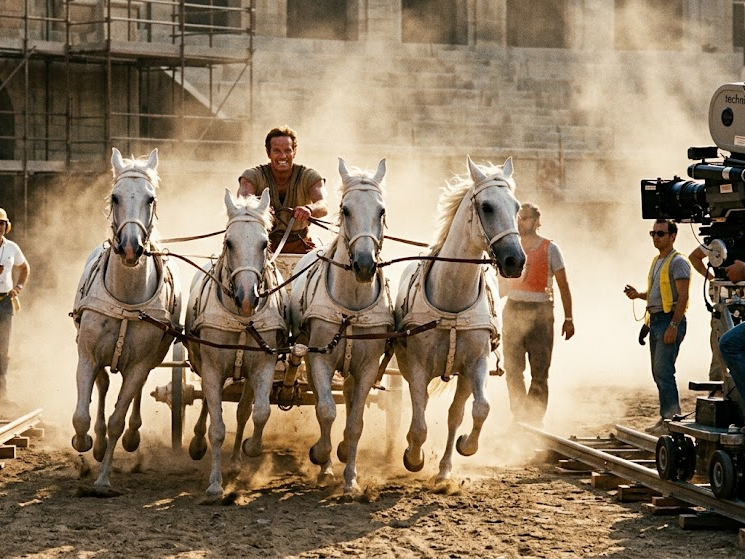
His father did not just sit in a chariot while stuntmen did the heavy lifting; he spent weeks learning to handle four powerful horses at high speeds.
His hands were often covered in blisters and raw skin, yet he refused to slow down the filming process.
“He wanted the audience to see his face in the middle of that chaos,” Fraser explains, highlighting his father’s dedication to authenticity.
Behind the scenes, the rivalry between Ben-Hur and Messala was fueled by Heston’s ability to maintain a simmering, quiet intensity.
He stayed in a state of focused concentration, rarely breaking character during the long days of the grueling shoot.
The Oscar he won for this role was a testament to his physical endurance as much as his emotional range.
The Heston Household: Stability in a Fickle Industry
In an industry where marriages often last as long as a film’s theatrical run, the Hestons were a remarkable anomaly.
Charlton Heston and Lydia Clarke were married for an astounding 64 years, a bond that served as the actor’s primary anchor.
Fraser insists that his father was a man of strict routine who viewed his home as a sanctuary away from the prying eyes of the press.
Inside their house, the “Hollywood Legend” disappeared, replaced by a father who was passionate about literature and the fine arts.
Charlton was an avid sketch artist and a lover of classic poetry, often spending his evenings reading aloud to his family.
“He was a protector of our childhood,” Fraser observes, noting how his father kept the glitz and glamour of show business at bay.
Despite being built like an athlete and possessing a booming baritone, Heston was a man of profound intellectual curiosity.
He valued education above all else and ensured that his children were raised with a strong sense of traditional values.
This stability allowed him to navigate the highs and lows of his career without ever losing his moral compass.
A Political Tapestry: From Civil Rights to Constitutional Rights
Charlton Heston’s political legacy is often a point of intense debate in the modern era, but Fraser urges people to look at the whole picture.
In the early 1960s, Heston was a pioneer for social justice, famously marching alongside Dr. Martin Luther King Jr. in Washington.
He stood as one of the very few white A-list stars who was willing to risk his career to advocate for the Civil Rights Movement.
Fraser emphasizes that his father’s later transition to a conservative icon was not a betrayal of those early values.
To Charlton Heston, the fight for civil rights and the fight for the Second Amendment were two sides of the same coin: individual liberty.
He believed that every citizen had a fundamental right to be treated with dignity and to defend their own life and property.
When he took the helm of the National Rifle Association (NRA), he did so with the same sense of duty he had brought to the picket lines in the 60s.
The “Cold Dead Hands” speech became a cultural touchstone, a moment of unyielding conviction that reflected his Michigan-born grit.
He was never afraid to be unpopular, choosing to speak his truth even when it meant being targeted by the growing “cancel culture” of the time.
The Battle with Memory: Facing Alzheimer’s with Dignity
In 2002, Charlton Heston performed what many believe was his most courageous act by appearing in a televised video to announce his health struggles.
He revealed that he was experiencing symptoms consistent with Alzheimer’s disease, choosing to share the news before the tabloids could twist the narrative.
Fraser recalls this period as a time of immense vulnerability and quiet strength for the entire family.
“He wanted to tell his fans goodbye while he was still the man they remembered,” Fraser explains with a soft, reflective tone.
The final act of his life was a slow retreat into the privacy of his home, where he was cared for by those who loved him most.
Fraser notes that even as the details of his famous films began to fade, his father’s love for the stage remained sharp.
He would often find his father reciting lines from Shakespeare in the middle of the night, the words of the Bard etched into his soul.
The man who had once stood atop Mount Sinai was now navigating the quietest and most difficult mountains of the human mind.
He handled the decline with the same stoicism and dignity that had defined his entire public life.
The Enduring Legacy: Why Charlton Heston Still Matters in 2026
As we observe the cinematic landscape of 2026, the absence of a figure like Charlton Heston is more apparent than ever.
He was a man who successfully bridged the gap between the theatrical traditions of the old world and the blockbuster era of the new.
His films taught audiences that a hero could be a man of deep faith, complex intellect, and massive physical strength.
Fraser Heston continues to work on his father’s archives, preserving the diaries and letters that tell the true story of the man behind the stone tablets.
The “truth” that has emerged is that Charlton Heston was a man of extreme discipline and surprising humility.
He never allowed the fame to change the core of who he was: a Michigan boy who loved to act and loved his family.
His legacy is not just found in the iconic images of him parting the sea or driving a chariot through the Roman dust.
It is found in the example of a 64-year marriage, a commitment to civil rights, and a life lived with unwavering integrity.
Charlton Heston was a titan of the screen, but he was a giant of a man in the real world as well.
The legend continues to inspire, but the man himself is the one we should truly admire.
Conclusion
Charlton Heston’s impact on Hollywood and global culture is a permanent fixture that refuses to dim with time.
Through the eyes of his son, Fraser, we have been given a unique opportunity to see the man behind the legendary roles.
We see a father who prioritized his family, a husband who stayed true to his vows, and an activist who fought for freedom.
His journey from the woods of Michigan to the apex of the film world is a quintessential story of the American dream realized through hard work.
While he will always be the Moses of our collective imagination, he was also a vulnerable and dedicated artist who struggled and succeeded like any other.
The truth revealed by Fraser Heston is that his father was a man of character who stood tall against every challenge life threw his way.
Charlton Heston was, and always will be, a singular force in the history of storytelling.
FAQs
Q1. How did Fraser Heston end up in ‘The Ten Commandments’?
Fraser Heston was cast as the infant Moses because the director, Cecil B. DeMille, wanted a baby that actually shared a family resemblance with Charlton Heston.
He was only a few months old when he was filmed in the basket on the water, making him one of the youngest “actors” in film history.
Q2. What was the secret to Charlton Heston’s long-lasting marriage?
The secret to his 64-year marriage to Lydia Clarke was a mutual commitment to family values and a shared passion for the arts.
They intentionally kept their private life separate from the Hollywood party scene, focusing on their home as a stable sanctuary for their children.
Q3. Did Charlton Heston really perform his own stunts in the chariot race?
While he had professional stunt doubles for the most life-threatening scenes, Charlton Heston performed a significant amount of the actual chariot driving himself.
He trained for weeks to handle the horses effectively, which added a level of realism to the film that remains unmatched by modern CGI.